
Nobody switches communication platforms for fun. It usually starts small, like a Slack message to your finance team asking “Wait, why did our Twilio spend jump again this month?” It then happens again next month, this time by 40%, until someone finally suggests: “Should we just look at alternatives to Twilio?” If that’s you, you’re asking the right question at the right time.
Twilio isn’t a bad platform; it built the entire CPaaS category, and Gartner’s 2026 Magic Quadrant for CPaaS still ranks it a leader. But “category-defining” and “still the best fit for you” aren’t the same thing.
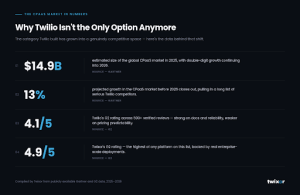
CPaaS market has grown into a genuinely competitive space, estimated by Gartner at roughly $14.9 billion in 2025, growing another 13% before this year closes out. Now that growth has pulled in a long list of serious Twilio competitors, several of which now beat it outright on price, automation, or the one thing Twilio still won’t offer: a white-label version you can call your own. By the end, you’ll also see why so many telcos and enterprises are looking for alternatives to Twilio, and we feel it’s high time you too do the same.
Why Is Everyone Suddenly Interested in Competitors of Twilio
On G2, Twilio holds a 4.1 out of 5 rating across 500+ verified reviews, with a recurring theme in the feedback: developers love the documentation and reliability, but many flag that pricing gets harder to track and more expensive as usage scales. That combination of a strong product and unpredictable economics is driving the search for alternatives.
- The bill doesn’t match the usage. Twilio’s own pricing page lists U.S. outbound SMS from about $0.0079 per message and outbound voice from $0.013 per minute. Although that’s reasonable at low volume, it gets brutal once you’re sending hundreds of thousands of messages a month, with carrier surcharges stacked on top.
- You need a brand, not just an API. Telcos, ISVs, and aggregators regularly hit the same wall: Twilio is not a white-label platform. You can build on it, but you can never sell it as your own.
- Your team isn’t all developers. Twilio hands you powerful primitives and expects you to assemble them. So, it is heavily developer-dependent, with limited built-in tools for non-technical marketing or support teams.
- The reviews back this up. Billing can be difficult to forecast month to month.
None of that makes Twilio a bad choice for a small app sending a few thousand OTPs a month. It just means the numbers change once you’re operating at real scale, and that’s exactly where these alternatives come in.
Best Twilio Alternatives Compared
| Platform | Starting Price | Standout Features | Best Fit | G2 Rating |
| Twixor | Custom (partner/ enterprise) | White-label CPaaS, agentic AI, WhatsApp + RCS + SMS + voice in one platform, wallet billing | Telcos, aggregators, enterprises | 4.9 / 5 |
| Infobip | Usage-based, ~$0.005/SMS (U.S.) | 800+ carrier connections, AgentOS agentic AI, fraud protection | Global enterprise omnichannel | 4.4 / 5 |
| Sinch | Usage-based, ~$0.0078/SMS (U.S.) | Wide channel range, AI-assisted routing, Super Network | High-volume transactional messaging | 4.4 / 5 |
| Vonage APIs | Usage-based, custom quote | Voice, SMS, video, Verify in one suite; 200-country reach | Full-suite programmable comms | 4.2 / 5 |
| Plivo | ~$0.0077/SMS (U.S.), pay-as-you-go | Transparent per-message pricing, clean docs, no minimums | Cost-conscious SMS & voice | 4.5 / 5 |
| MessageBird (Bird) | Free tier, then ~$0.0075/msg or $49/mo | Omnichannel inbox on top of raw APIs | Teams wanting an app, not just an API | 3.9 / 5 |
| Yellow.ai | Free tier; Enterprise ~$50K–$100K+/yr | Generative AI chat & voicebots, 35+ channels, 150+ integrations | AI-first customer service | 4.4 / 5 |
| Wati | $59–$279/month (Growth to Business) | Official WhatsApp Business API, no-code bots, shared inbox | SMBs needing WhatsApp only | 4.6 / 5 |
| Exotel | ~$106–$530 prepaid credit bundles | Cloud telephony, IVR, contact center, local carrier reach | India / Southeast Asia telephony | 4.3 / 5 |
| RingCentral | $20–$35/user/month (annual) | Business phone + video + team chat + contact center | Unified comms & contact centers | 4.3 / 5 |
| 8×8 | $15–$44/user/month (annual) | Voice, video, chat, unlimited calling to 48 countries | All-in-one UC and CX | 4.1 / 5 |
| Kaleyra | Custom (contact sales) | Enterprise messaging + voice, strong emerging-market reach | Regional enterprise messaging | 4.3 / 5 |
| Telesign | Custom, per-verification pricing | Identity verification, OTP, fraud-risk scoring | Verification & fraud prevention | 4.3 / 5 |
1. Twixor, the one you brand as your own
Twixor is an agentic AI-powered CPaaS and conversational automation platform built for telcos, aggregators, and enterprises that want more than raw messaging APIs. It unifies WhatsApp (as a full WhatsApp marketing platform), SMS, RCS, email, voice, web chat, and social channels into a single layer, with automation and multi-tenant billing built in from day one.
While Twilio forces you to resell someone else’s brand, Twixor lets you launch your own branded CPaaS, complete with dashboards, custom domains, and per-tenant billing. You can add in built-in AI agents and analytics, and non-technical teams get a finished, sellable product. Twixor’s partnership track record with large telecom aggregators demonstrates this at enterprise scale.
If you’re evaluating communication platforms beyond direct Twilio competitors, explore our comparison of the best CPaaS platforms to understand how leading providers compare in terms of omnichannel capabilities, AI automation, scalability, integrations, and enterprise requirements.
Key features: a low-code journey builder, pre-built conversational templates, a fully rebrandable white-label CPaaS platform, wallet-based and ISV billing, and native support for partner/reseller management.
Pricing: Custom, based on channels, volume, and partner model | G2 rating: 4.9 / 5
2. Infobip, the global heavyweight
If your business needs global reach with good deliverability in markets outside North America, Infobip’s telco-grade infrastructure is hard to argue with. Gartner’s 2026 CPaaS report highlights Infobip’s early push into agentic AI through its AgentOS platform and a carrier network of more than 800 global connections.
Key features: SMS, WhatsApp, RCS, voice, and email support with enterprise-grade routing and fraud protection
Pricing: Pay-as-you-go, quoted by channel and destination (U.S. SMS runs at $0.005 per message) | G2 rating: 4.4 / 5
3. Sinch, built for volume
Sinch combines messaging, voice, verification, and email under one roof with AI-assisted routing to optimize cost and delivery. It’s good for enterprises that send high transactional SMS volumes like OTPs, delivery alerts, and that kind of thing, and want compliance and quality-of-service guarantees.
Key features: AI-assisted routing to optimize cost and delivery speed at scale
Pricing: Usage-based, roughly $0.0078 per SMS in the U.S. | G2 rating: 4.4 / 5
4. Vonage APIs, the direct API-for-API swap
If your team already thinks in Twilio-style API calls, Vonage is probably the least disruptive migration on this list. It offers a full-suite programmable communications stack with voice, SMS, video, and Verify.
Key features: Programmable voice, SMS, video, and Verify (2FA), with connectivity across roughly 200 countries and strong developer documentation.
Pricing: Usage-based and quoted by country; free trial credit to test | G2 rating: 4.2 / 5
5. Plivo, the budget-conscious developer’s pick
Plivo is a developer-friendly platform built around transparent, competitive per-message and per-minute pricing, making it a frequent pick for teams that mainly need SMS and voice at lower cost.
Key features: SMS, voice, and WhatsApp APIs with a clean developer experience and a solid admin console.
Pricing: Around $0.0077 per SMS (U.S. long code), pay-as-you-go, no minimum spend | G2 rating: 4.2 / 5
6. MessageBird (Bird), APIs with an inbox on top
MessageBird, now largely rebranded as Bird, layers an omnichannel inbox and automation tools on top of SMS, WhatsApp, voice, and chat APIs. It suits teams that want something closer to an app than a pile of endpoints. It has the lowest G2 rating on this list, with some reviewers flagging integration fees that aren’t always obvious upfront.
Key features: SMS, WhatsApp, voice, and chat APIs in an omnichannel inbox so non-developers can actually see and manage conversations.
Pricing: Limited free tier, paid plans from around $49/month, with per-message rates near $0.0075 for SMS depending on region. | G2 rating: 3.9 / 5
7. Yellow.ai, the AI-first alternative
Yellow.ai is a generative-AI customer service platform built around chatbots and voicebots across web, mobile, and messaging. It offers more out-of-the-box CX capability than Twilio’s Studio or Flex for teams that want built-in conversational AI.
Key features: Generative AI chatbots and voicebots across 35+ channels, 150+ pre-built integrations, and support for 135+ languages.
Pricing: Usable free tier (100 monthly tracked users), enterprise plans somewhere between $50,000–$100,000+ a year depending on volume and channels. | G2 rating: 4.4 / 5
8. Wati, the WhatsApp specialist
Wati is a WhatsApp-first platform built on the official WhatsApp Business API, aimed squarely at SMBs that want shared inboxes, no-code bot building, and campaign broadcasts without touching code.
Key features: Genuinely cheaper alternative to Twilio if WhatsApp is your only real channel need
Pricing: Growth at $59/month, Pro at $119/month, Business at $279/month (annual billing), plus WhatsApp’s own per-message conversation costs | G2 rating: 4.6 / 5
9. Exotel, the regional specialist
Exotel is a cloud telephony and CPaaS provider operating in India and Southeast Asia. It combines cloud contact center tools, IVR, and virtual numbers with strong local carrier relationships. For regional deployments, it often beats a global Twilio setup on cost and local compliance familiarity.
Key features: Cloud telephony, IVR, virtual numbers, and a contact center suite, with deep local carrier relationships across India and Southeast Asia.
Pricing: Prepaid credit bundles roughly $106 (Starter), up to $530 (High-volume) | G2 rating: 4.3 / 5
10. RingCentral, unified comms with a contact center attached
RingCentral is less a pure CPaaS swap and more a full communications platform for teams that want internal collaboration and customer-facing channels under one login.
Key features: Business phone system, video meetings, team messaging, and a full contact center suite (RingCX), with deep CRM integrations.
Pricing: Core ($20/user/month), Advanced ($25/user/month), Ultra ($35/user/month) | G2 rating: 4.3 / 5
11. 8×8, the all-in-one UC play
8×8 works well for companies that want to consolidate internal communication and customer support tooling into one bill instead of three.
Key features: Voice, video, chat, and contact center tools in a single platform (branded XCaaS), with unlimited calling to up to 48 countries on higher tiers.
Pricing: Express ($15/user/month), X2 ($24/user/month), X4 ($44/user/month)| G2 rating: 4.1 / 5
12. Kaleyra, the enterprise messenger for emerging markets
It is a reasonable shortlist candidate if your growth markets sit outside the usual U.S./EU CPaaS comfort zone.
Key features: Enterprise-grade SMS, voice, and messaging APIs with a strong footprint in Latin America, the Middle East, and parts of Asia.
Pricing: Custom | G2 rating: 4.3 / 5
13. Telesign, the verification specialist
If your actual problem is fake sign-ups and OTP fraud rather than broad customer messaging, Telesign solves a narrower, but very real problem better than a general CPaaS will.
Key features: Phone verification, OTP delivery, and fraud-risk scoring APIs, built specifically around identity and trust rather than general messaging.
Pricing: Custom, typically billed per verification or per API call | G2 rating: 4.3 / 5
How to Choose the Right Twilio Alternative
- What’s actually driving you away from Twilio? Cost at scale, lack of white-labeling, or missing automation each points to a different best fit.
- Do you need a brandable platform or just an API?
If you’re a telco, ISV, or reseller, prioritize platforms like Twixor that offer genuine white-labeling. Comparing the best white-label CPaaS platforms can help you evaluate branding flexibility, multi-tenant architecture, billing capabilities, and reseller management before choosing a provider.
- Which channels matter most? WhatsApp-only needs (Wati) look very different from full omnichannel requirements (Twixor, Infobip, Sinch).
- How predictable is the pricing model? Usage-based pricing is flexible but can spike; ask every vendor for a worst-case monthly estimate at your expected volume.
- How much can non-technical teams do without engineering? Low-code journey builders and AI agents reduce dependency on your dev team long after go-live.
Why Twixor Is the Best Alternative to Twilio for Telcos and Enterprises
Most of the Twilio alternatives above are, functionally, variations on the same thing Twilio does: APIs you pay for by the message or minute. That’s a fine model if you just need plumbing. Twixor is a different bet. It’s built on the assumption that the businesses evaluating competitors of Twilio want to own the platform, automate the busywork, and stop hiring developers for every new customer journey.

So, a few things that make that real, not just a pitch:
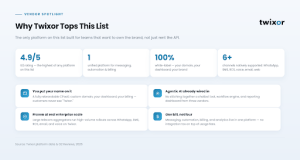
You get to put your name on it. Twixor’s white-label voice agent feature is the core that lets telcos, aggregators, and ISVs launch a fully branded communications platform. Custom domain, your dashboard, your billing, your customers never seeing “Twixor” anywhere.
Agentic AI and automation are already wired in. Instead of stitching together a chatbot tool, a workflow engine, and a reporting dashboard from three vendors, Twixor’s conversational AI platform ships as one connected system.
It’s been proven at a scale that matters. Large telecom aggregators have run real, high-volume rollouts across WhatsApp, SMS, RCS, email, and voice on Twixor. You can see that in its partnerships, and it shows up in the numbers too: a 4.9/5 G2 rating, the highest on this list.
The total bill tends to be lower, not just the per-message rate. When messaging, automation, billing, and analytics live in one platform instead of four. So, you’re not paying integration tax on top of usage fees.
Final Take
Twilio isn’t going anywhere, and it’s still a genuinely solid choice. But it’s no longer the only serious option, and for many businesses, it isn’t even the best one. Twilio alternatives on this list prove there’s real, credible choice out there now, especially if you’re chasing lower costs, deeper WhatsApp automation, or a platform you can actually call your own.
If that last one is what’s been missing, a white-label CPaaS with AI automation built in and a track record at real enterprise scale, Twixor is worth 20 minutes of your time. Book a demo and see what it looks like running under your brand instead of someone else’s.
Frequently Asked Questions
Are there cheaper alternatives to Twilio?
Yes. Plivo is well known for low per-message and per-minute pricing, and Wati offers flat, WhatsApp-focused plans that avoid Twilio’s usage-based unpredictability. Twixor’s bundled model can also lower total cost by folding automation and billing into one platform instead of several tools.
Why are so many businesses searching for Twilio competitors right now?
Rising costs at scale, a lack of white-label options, limited built-in automation for non-technical teams, and unpredictable monthly billing are the most common reasons companies start comparing alternatives to Twilio.
Which Twilio alternative is best for WhatsApp and RCS messaging?
Twixor, Infobip, and Wati are strong choices for WhatsApp. Twixor also supports RCS natively, making it one of the few platforms that covers both rich messaging channels alongside SMS, email, and voice in one system.
Is Twixor suitable for enterprise-scale deployments?
Yes. Twixor is built for multi-tenant, high-volume use cases and has powered deployments for telecom aggregators and large enterprises, backed by a 4.9/5 G2 rating — one of the highest in the CPaaS category.